
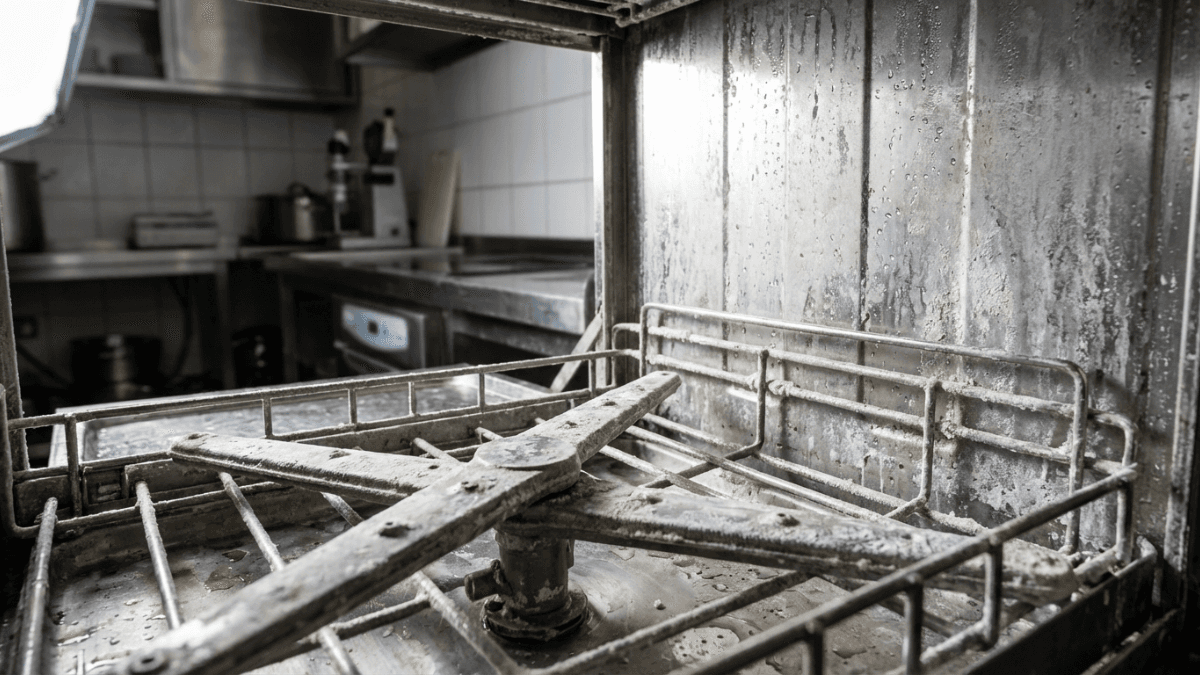
Scale prevention at the dishwasher inlet is the single most cost-effective intervention available in a busy commercial kitchen. From the moment mineral-laden water reaches a high-temperature wash tank, dissolved calcium and magnesium begin to precipitate onto heating elements, spray arms and glassware, eroding cleaning performance and shortening equipment life.
Sovereign Water protects commercial warewashing across hotels, restaurants, clinics and contract caterers in Kuwait and the GCC, combining pre-treatment with planned servicing. Here is how scale forms, what it actually costs, and which treatment fits which site.
Why scale forms in a warewasher
Heat drives dissolved calcium and magnesium out of solution, and they crystallise onto the hottest surfaces in the machine. Calcium bicarbonate dissolved invisibly in cold water decomposes above about 60 degrees Celsius into calcium carbonate, the chalky deposit familiar from kettles. A commercial warewasher running 60 to 85 degree cycles several times an hour makes that reaction constant and cumulative.
Kuwait's supply complicates the picture. Desalinated water is re-mineralised before distribution, and many buildings blend in tanker or well water with much higher hardness and TDS. Two kitchens a street apart can see very different scaling rates, which is why we always specify for your actual supply rather than an assumption.
What untreated water costs
- Scale on a heating element acts as insulation, so the element works harder to heat the water, lengthening cycles and raising energy bills.
- Spray arms and jets block progressively, so racks come out streaked and glassware cloudy.
- Elements and pumps fail early, and manufacturer warranties on commercial warewashers commonly require water pre-treatment; running without it can void cover.
The treatment options
Base exchange softeners
The workhorse answer to hardness: resin swaps calcium and magnesium for sodium, stopping scale at source. Duplex configurations regenerate one vessel while the other serves, so the kitchen never sees hard water.
Reverse osmosis
Where total dissolved solids are high, RO removes the broader mineral load as well as hardness, delivering spot-free glassware. It is the standard answer for premium glass-washing and for sites on heavily blended supply.
Combined systems
Demanding sites often run softening ahead of RO: the softener protects the membranes, the RO polishes the result. We size both around the machine's flow and the site's throughput.
Choosing correctly
Three steps, in order: specify for the incoming supply, match the treatment to the machine manufacturer's specification, and plan for throughput so regeneration or membrane capacity never falls behind service. Our engineers handle all three in a site assessment, and our maintenance plans keep salt, media and membranes on schedule afterwards.
Frequently asked questions
Can I just descale the machine regularly instead?
You can, but you are paying skilled labour to manage a problem prevention removes, and the damage between descales still accumulates.
Softener or RO for glassware?
Softening stops scale; RO adds the low-TDS polish that makes glasses dry spotless. Premium bars usually want RO.
Request a quote and we will tell you exactly which one your kitchen needs.